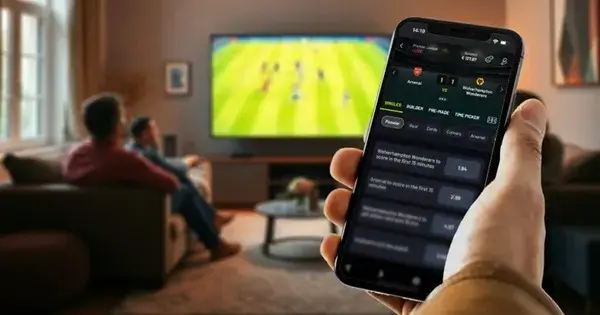
If you watched live betting ten or twelve years ago, it felt slightly behind the game. That was true across most major sports, but it was especially noticeable in football. A goal would go in. Markets would freeze. Everyone would wait. Prices would come back up, usually adjusted in a careful, almost hesitant way. Now it feels different. Not just quicker. Sharper. In modern sports betting environments, odds can move while the attack is still unfolding. A dangerous spell of pressure, a sequence of corners, even a visible shift in tempo can influence prices before anything concrete shows up on the scoreboard. The betting layer no longer reacts only to big moments. It reacts to flow. And that shift, across sports but particularly in football, didn’t happen overnight.
When Live Betting Was Still Catching Up
Early in-play markets were built around major events. Goals. Red cards. Halftime. Football betting in that era was reactive by design. Traders needed breathing space to adjust their numbers, and that meant suspensions were frequent and sometimes longer than viewers expected. You would see an attack building, then the market would disappear, then reappear once the dust had settled. The whole experience felt like a stop-start.
As data feeds improved, delays shrank. Official event tracking became faster and more precise, and the backbone of modern football betting began to change. Platforms such as Betway invested heavily in real-time data integration and automated trading systems. Instead of waiting for someone to manually update prices, algorithms began recalculating probabilities constantly, second by second. That shift turned live betting from reactive to fluid. Odds were no longer responding only to what had already happened. They started adjusting to what looked likely to happen next.
A team winning more second balls in midfield. A fullback getting isolated again and again on one side. A striker starting to drift into dangerous pockets of space. In modern football betting environments, those subtle patterns can nudge markets before the scoreboard changes. What once required a goal to trigger movement now reacts to pressure, territory, and tempo. The market is not just watching the match. It is interpreting it in real time.
The Quiet Explosion of Micro-Markets
Speed was one part of the evolution. The other was fragmentation. Instead of focusing on the final result, live betting began slicing matches into smaller pieces. The next corner. The next card. The next five minutes. A shot on target before the 70th minute. These micro-markets don’t live long. They open, breathe for a few minutes, and close. Then another one replaces them.
It mirrors how people actually watch football now. Conversations move moment to moment. Social feeds light up during a single attack. Viewers comment on short bursts of momentum rather than waiting for full-time. Micro-markets fit that rhythm. You are not committing to ninety minutes. You are reacting to the next phase.
Decision Windows Are Tighter
With more speed comes pressure. Prices don’t sit still. Hesitate for ten seconds and the number might already be gone. In that sense, live betting has started to resemble trading more than traditional wagering. The interesting part is that momentum itself has become something you can engage with. If one side pins the other back for three or four minutes, short-term markets adjust. Not because a goal happened, but because the probability feels heavier in one direction. Of course, football has a way of punishing overconfidence. A dominant spell can end with a counterattack the other way. That tension is part of the appeal. You are not just betting on outcomes. You are interpreting energy.
Built for Short Attention Spans, But Not Because of Them
There is an assumption that faster markets exist because people are impatient. That’s too simple. The real shift is behavioral. Many sessions today are fragmented. Someone checks in during a commute. Places a quick position during halftime of another match. Look at the screen between conversations. Micro-markets suit that pattern. They resolve quickly. There’s closure. You are not stuck waiting half an hour to know where you stand. It’s less about impatience and more about flexibility.
Where This Is Going
The direction seems obvious: tighter integration between live data and pricing engines. More event-specific options. Possibly even customized displays that highlight certain types of markets based on past behavior. But the core dynamic will stay the same. Football unfolds continuously. Live betting is trying to stay in step with that flow. The interesting part is not just how fast it has become, but how granular. A match is no longer one long prediction. It is dozens of small moments, each briefly turning into a market before disappearing again. And in that narrow space between a pass and a shot, there is now enough time for a price to form, move, and settle.